
Empty legs 15th January – 25th January 2009
Le Bourget - Stuttgart LFPB - EDDS 24th January 09
Gulfstream G550 Seats: 16 /YOM Jan 07
London/Luton - White Plains EGGW - KHPN 15th January 09
Gulfstream G450 Seats: 14 /YOM Aug 05
Moskau/Vnukovo - Stuttgart UUWW - EDDS 18th January 09
Embraer Legacy Seats: 13 /YOM Jul 08
Stuttgart - Beirut EDDS - OLBA 24th January 09
Gulfstream G550 Seats: 16 /YOM Jan07
Tashkent - Stuttgart UTTT - EDDS 16th January 09
Airbus A 319CJ Seats: 46/ YOM Dec 99
Transient Aircraft 15th January -25th January 2009
Berlin Schönefeld EDDB 21st - 25th Jan 09
Challenger CL604 Seats: 9 /YOM Dec 03
Düsseldorf EDDL 15th January 09
Embraer Legacy Seats: 12/YOM Feb 06
Frankfurt Hahn EDFH 15th - 18th Jan 09
Lear 45 Seats: 6 /YOM Aug 08
Moskau /Vnukovo UUWW 15th - 18th Jan 09
Embraer Legacy Seats: 13 /YOM Jul 08
Moskau/Domodedovo UUDD 17th - 25th Jan 09
Gulfstream G 450 Seats: 14 /YOM Aug 05
Moskau/St. Petersburg ULLI 15th - 25th Jan 09
Challenger CL604 Seats: 9 /YOM Nov 04
München EDDM 15th - 25th Jan 09
Lear 40 Seats: 6 /YOM Sep 08
Palermo LICJ 22nd January 09
Lear 60 Seats:8 /YOM Jul 03
Tashkent UTTT 15th - 25th Jan 09
Airbus A 319CJ Seats: 46/YOM Dec99
White Plains KHPN 15th - 16th Jan 09
Gulfstream G450 Seats: 14 /YOM Aug 05
Zürich LSZH 15th - 25th Jan 09
Challenger CL 300 Seats: 8 /YOM Apr 06
Wednesday, January 14, 2009
Friday, May 9, 2008
GAMA RELEASES FIRST QUARTER SHIPMENTS
Yesterday, the General Aviation Manufacturers Association (GAMA) announced first quarter shipment and billings figures. Total industry billings were up 16.1 percent to $5.3 billion, an all-time high for the first quarter, while total shipments were down by 7.5 percent."This past quarter's overall industry billings remain impressive, with the turbine segments showing dramatic increases. The trend of increasing market share occurring outside of North America continues for most manufacturers. It is apparent, however, that current uncertainty in the U.S. economy is having an affect on some of the offerings in the piston spectrum of aircraft,” said Pete Bunce, GAMA president and CEO. “Last year, 67 percent of piston deliveries were to the North American market, making this segment the most susceptible to softness in the U.S. economy. However, as worldwide markets continue to expand, we see more capability to insulate manufacturers from the economic dynamics of any one specific region."Piston-powered airplane shipments totaled 399 units compared to 554 units delivered in the first quarter of 2007, a 28.0 percent decrease. Turboprop shipments increased from 79 units in the first quarter last year to 85 units in 2008. Business jet shipments totaled 297 units in the first quarter of 2008, a remarkable 40.8 percent increase over the 211 units delivered in the first quarter of 2007. FIRST QUARTER SHIPMENTS OF AIRPLANES MANUFACTURED WORLDWIDE
| Aircraft Category | 2007 | 2008 | CHANGE |
|---|---|---|---|
| Pistons | 554 | 399 | -28.0% |
| Turboprops | 79 | 85 | +7.6% |
| Business Jets | 211 | 297 | +40.8% |
| Total Shipments | 844 | 781 | -7.5% |
Tuesday, April 15, 2008
Airlines vs Business Aviation

Sunday, March 30, 2008
Embraer Demos Legacy 600 in Malta
 |
| Legacy 600 |
 In today's article, prior to the visit by Embraer visit to Malta on the 4th April 2008, we have a look in more detail at the Legacy 600 which will be landing in Malta on Thursday evening.
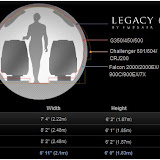
The Legacy 600 jet provides premium comfort and privacy for up to 16 passengers in three distinct seating areas. Interior standard features include first-class leather seats, a plush divan, an elegant credenza, and spacious tables for dining or meetings. The aircraft also has a fullsize galley for hot and cold meals, a full-width aft lavatory, wardrobe and storage cabinet, and an entertainment system with DVD players and satellite telecommunications. Optional High Speed Data (HSD) and Wireless Fidelity (Wi-Fi) capabilities allow customers to browse the Internet, access e-mails and transfer files. The 240-cubic-foot (6.8-cubic-meter) baggage compartment of the Legacy 600 is one of the largest in the industry and is easily accessible during flight, for greater passenger convenience.
The aircraft cruises at a speed of up to Mach 0.80 and has a range of 3,250 nautical miles (6,019 km or 3,740 miles) with eight passengers and NBAA IFR reserves. This range, bolstered by superior passenger and luggage capacity, enables customers to fly nonstop from New York (U.S.) to London (U.K.); from London or Geneva (Switzerland) to Dubai (United Arab Emirates); from Singapore (Singapore) to Beijing (China) or to Port Moresby (Papua New Guinea); and from Jakarta (Indonesia) to Melbourne (Australia) at lower operating costs than competitive aircraft with a similar cabin size. Additionally, the Legacy 600 is one the only super mid-size jet certified to operate into and out of the London City and Cannes-Mandelieu airports.
The twin-engine business jet is based on the successful ERJ 145 regional jet family platform that has accumulated over 12.5 million flight hours on 1,000 aircraft. With a platform designed to endure an average of 2,500 hours per year, low operating cost, and a track record of over 99 percent dispatch reliability, the Legacy 600 offers luxurious comfort and delivers high utilization and high availability.
Priced at US$ 25.41 million, based on January 2008 economic conditions, in the baseline configuration, for FAA certification, 131 Legacy jets currently operate in 23 countries. Also available in Shuttle and Shuttle High Capacity (HC) configurations, the Legacy is designed to provide comfort and functionality. The Legacy Shuttle accommodates from 16 to 19 passengers in business class comfort. The Shuttle HC version enhances owner productivity and comfortably seats as many as 37 passengers in a superior airline-quality interior.
If you are in the market for purchasing a business jet and you will be in Malta, this is an excellent opportunity to have a close inspection of this magnificent aircraft. Drop us an e-mail to schedule an appointment.
In today's article, prior to the visit by Embraer visit to Malta on the 4th April 2008, we have a look in more detail at the Legacy 600 which will be landing in Malta on Thursday evening.
The Legacy 600 jet provides premium comfort and privacy for up to 16 passengers in three distinct seating areas. Interior standard features include first-class leather seats, a plush divan, an elegant credenza, and spacious tables for dining or meetings. The aircraft also has a fullsize galley for hot and cold meals, a full-width aft lavatory, wardrobe and storage cabinet, and an entertainment system with DVD players and satellite telecommunications. Optional High Speed Data (HSD) and Wireless Fidelity (Wi-Fi) capabilities allow customers to browse the Internet, access e-mails and transfer files. The 240-cubic-foot (6.8-cubic-meter) baggage compartment of the Legacy 600 is one of the largest in the industry and is easily accessible during flight, for greater passenger convenience.
The aircraft cruises at a speed of up to Mach 0.80 and has a range of 3,250 nautical miles (6,019 km or 3,740 miles) with eight passengers and NBAA IFR reserves. This range, bolstered by superior passenger and luggage capacity, enables customers to fly nonstop from New York (U.S.) to London (U.K.); from London or Geneva (Switzerland) to Dubai (United Arab Emirates); from Singapore (Singapore) to Beijing (China) or to Port Moresby (Papua New Guinea); and from Jakarta (Indonesia) to Melbourne (Australia) at lower operating costs than competitive aircraft with a similar cabin size. Additionally, the Legacy 600 is one the only super mid-size jet certified to operate into and out of the London City and Cannes-Mandelieu airports.
The twin-engine business jet is based on the successful ERJ 145 regional jet family platform that has accumulated over 12.5 million flight hours on 1,000 aircraft. With a platform designed to endure an average of 2,500 hours per year, low operating cost, and a track record of over 99 percent dispatch reliability, the Legacy 600 offers luxurious comfort and delivers high utilization and high availability.
Priced at US$ 25.41 million, based on January 2008 economic conditions, in the baseline configuration, for FAA certification, 131 Legacy jets currently operate in 23 countries. Also available in Shuttle and Shuttle High Capacity (HC) configurations, the Legacy is designed to provide comfort and functionality. The Legacy Shuttle accommodates from 16 to 19 passengers in business class comfort. The Shuttle HC version enhances owner productivity and comfortably seats as many as 37 passengers in a superior airline-quality interior.
If you are in the market for purchasing a business jet and you will be in Malta, this is an excellent opportunity to have a close inspection of this magnificent aircraft. Drop us an e-mail to schedule an appointment.Saturday, March 29, 2008
Embraer Legacy will be visting Malta
 EMBRAER LEGACY 600 On the 4th April 2008, Embraer is expected to make a visit to Malta with a Legacy 600. Embraer a Brazilian manufacture would be the first business jet manufacturer to demo a business jet in Malta. Other than the Legacy 600 a heavy jet, Embraer also manufacture smaller jets uch as the Phenom 100 and the Phenom 300. However Embraer are not only business jets manufacturers but also manufacture airliners jets. In this series of 2 articles we will investigate in detail the Legacy 600 in anticipation of the demo flight expected in Malta on Thursday, 4th April, 2008.
 Thursday, March 20, 2008
Malta: Not just an island in sun




 Posts
Posts

